Why Google’s SEO + AI Optimization Guide Is Really About Escaping Commodity Content
For the last two years, perhaps enrollment marketers have been asking the same question:
“How do we optimize for AI search?”
Google just answered that question with unusual clarity.
It is editorial.
In its new guide on optimizing for generative AI features, Google repeatedly emphasizes something that should make every enrollment marketer slightly uncomfortable:
Non-commodity content.
For years, SEO rewarded scale. Publish enough “Top 10 Tips” articles, structure them properly, and eventually traffic arrived. But AI-generated search changes the economics of visibility because retrieval systems do not need another generic explanation of a topic. They already have infinite access to mediocre
AI systems retrieve what is distinctive.
Google’s own example in the documentation is telling. Commodity content looks like:
“7 Tips for First-Time Homebuyers.” In higher education, this might be “5 Tips for Choosing the Right College”.
Non-commodity content looks like:
“After hundreds of admissions conversations with prospective students, these were the moments that consistently changed enrollment decisions.”
The difference is not formatting or schema.
It is specificity, dare we say humanity.
One article could be written by anyone with access to a chatbot. The other requires experience, consequence, narrative, and perspective.
That distinction is becoming foundational because AI search is built on retrieval-augmented generation (RAG). These systems pull from indexed content to construct answers. If your content simply reorganizes common knowledge, the model has no compelling reason to surface your version over thousands of others saying the same thing.
This is why so much AI-generated content already feels invisible.
The internet is entering a phase where production is cheap, but perspective is expensive.
That changes the value for most enrollment marketers.
That means:
- First-party observations
- Original research
- Operational insights
- Real student stories
- Contrarian points of view
- Specific failures
- Specific outcomes
- Human judgment
In other words, the things most AI-generated content is structurally weak at producing authentically.
This is also why Google’s guide spends time myth-busting tactics marketers hoped would become shortcuts.
That is Google effectively saying: Stop trying to reverse-engineer the machine and start becoming a source worth reading.
There is a broader implication here for institutions.
For years, content strategy was built around discoverability after intent formed. Someone searched, schools competed, and traffic followed.
AI compresses that journey.
Now recommendations, summaries, and comparisons increasingly happen in a zero click environment. That means visibility itself becomes the product.
And visibility in AI systems is heavily influenced by whether your content contributes something meaningful to the student search experience.
The institutions that will win in AI-mediated discovery are the ones capable of producing:
- recognizable expertise
- repeated perspective
- clear narrative territory
- and consistent signals across platforms
Because retrieval systems prioritize information gain.
That is the part many enrollment marketers are still missing.
The future of SEO is not less human. It is more human in ways that are difficult to automate.
The irony is almost perfect.
The easier AI makes content creation, the more valuable actual experience becomes.
And this has major consequences for how teams should operate.
Writers become interviewers.
Subject matter experts become strategic assets.
Student experiences become source material.
Podcasts become source inventory.
Internal conversations become content goldmines.
The institutions still treating content like a volume game are going to flood the internet with increasingly interchangeable material while wondering why visibility declines.
Meanwhile, smaller institutions with sharper perspectives will punch above their weight because they are producing things AI systems cannot easily synthesize elsewhere.
The future belongs to institutions that can say something only they can say.




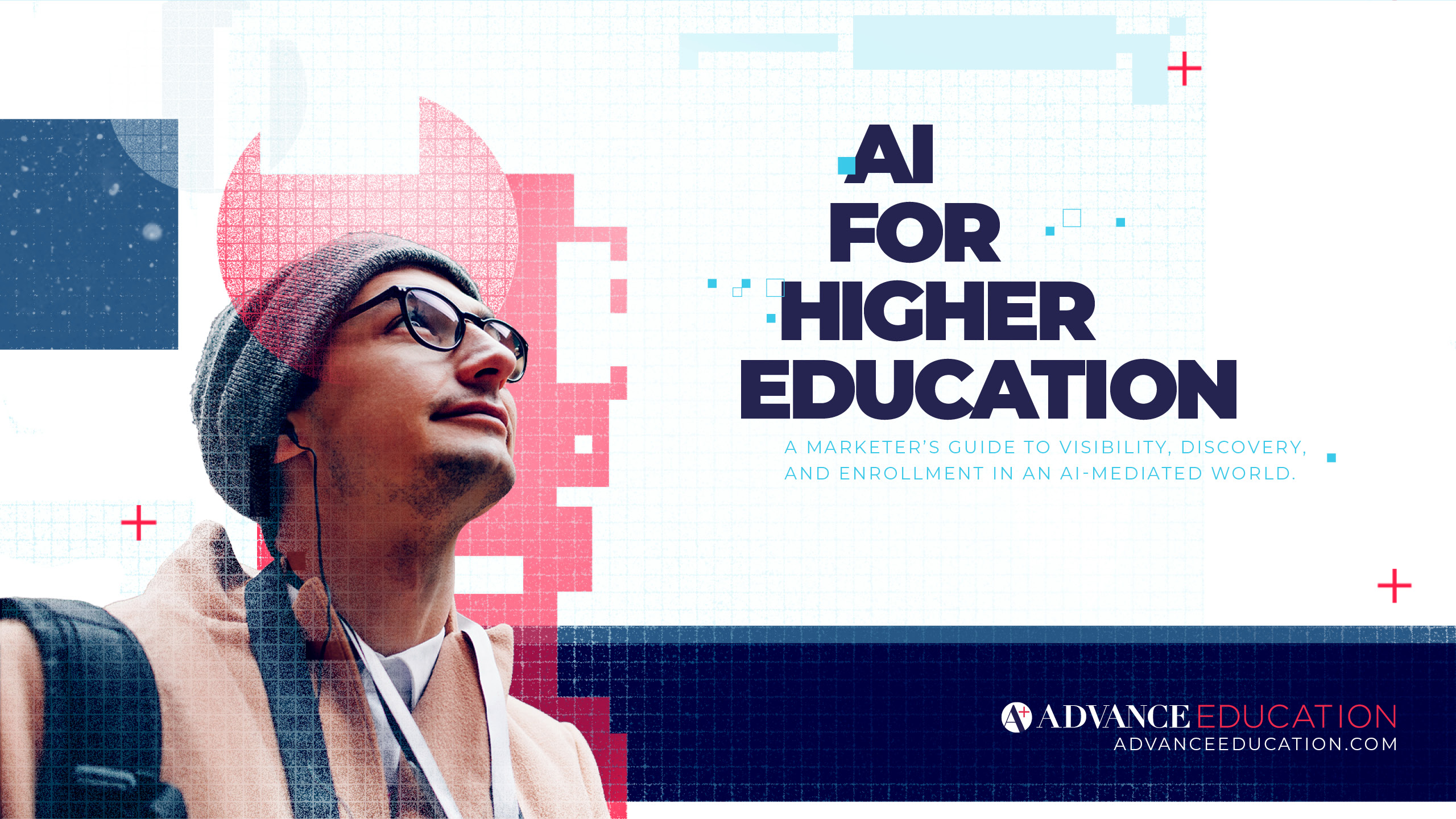
OUR LATEST WHITEPAPER
AI for Education
A Marketer’s Guide to Visibility, Discovery, and Enrollment in an AI-Mediated World
Prospective students aren’t just searching differently. They’re discovering, comparing, and evaluating institutions through AI before they ever visit a website.
This guide explores how AI is reshaping the enrollment journey and what enrollment marketers can do to improve visibility, build trust, and prepare for the future of student discovery.