The Best Content Your Brand Will Ever Make Is Already Living Inside Your Team
Four astronauts are currently on their way back from the Moon.
While they were out there, 248,000 miles from Earth, no Wi-Fi, no cellular signal, they were still posting.
Not directly. Commander Reid Wiseman explained it before launch: the crew would write the content, send the ideas, transmit the photos down through the Deep Space Network, and a NASA social media coordinator named Camille would handle the posting. The astronauts couldn’t hit “publish.” But the voice, the perspective, the moment, all of it came from them.
And the content broke through.
The photos that stopped people mid-scroll weren’t taken with NASA’s professional camera rigs. They were selfies, shot on an iPhone 17 Pro Max’s front-facing camera, with astronaut faces framed against the curve of the Earth. What made them land wasn’t production value. It was the unmistakable sense that someone who genuinely lived this moment wanted you to see it.
That’s the lesson most content teams are sleeping on.
You Already Have People Like This
Every organization has them, the employee who tears up talking about a patient recovery. The faculty member who still gets excited about their research. The admissions counselor who chose this school for a reason.
These people aren’t PR assets. They’re not “thought leadership opportunities.” They’re true believers. And true believers make content that no agency, no creative brief, and no AI prompt can replicate.
The problem isn’t that you don’t have them. The problem is that you’ve built your content operation in a way that requires them to become someone else before they can participate.
You’ve handed them a brand voice guide. You’ve put them through an approval chain. You’ve asked them to strip out everything personal before anything can go live.
And then the content feels hollow.
The NASA Model Is Simpler Than You Think
What NASA did with the Artemis II crew wasn’t complicated. It was structured.
The astronauts weren’t given free rein to post whatever they wanted. They had a coordinator. They had a workflow. They had a system that let authentic voices move through an institutional channel without getting sanitized into oblivion in the process.
That’s the model. Not “let everyone post anything.” Not “build a brand ambassador program” that turns real people into walking talking points. It’s: find the people who love what you do, give them a structure that protects both of you, and then get out of the way.
The coordinator’s job isn’t to rewrite the voice. It’s to preserve it while handling the logistics the creator can’t.
What This Looks Like in Practice
Start with the believers, not the volunteers.
The people who raise their hand to be in marketing videos are often the wrong people. Find the ones who talk about their work the way Reid Wiseman talks about space, like they’d do it for free, and probably did.
Build the scaffold, not the script.
Give them a format, a frequency, a point of contact. Don’t give them approved talking points. If they need talking points, they’re not the right person.
Let the coordinator be a producer, not an editor.
The coordinator’s job is amplification and logistics, posting at the right time, formatting for platform, handling the back-and-forth. Not sanitizing the voice into something that sounds like every other brand.
Separate authenticity from accuracy.
Yes, you still need legal and compliance review where it matters. But that’s a narrow lane. Most content teams have expanded that lane into everything and killed the voice in the process.
The Earth looks different when you’re seeing it through someone who’s actually there.
Your audience knows the difference between a brand that hired someone to say something and a person who couldn’t help but say it.
The astronauts didn’t make great content because they had iPhones and a good backdrop. They made great content because they meant it.
You have people who mean it. The question is whether your content operation is built to let them through or built to stop them at the door.


OUR LATEST WHITEPAPER
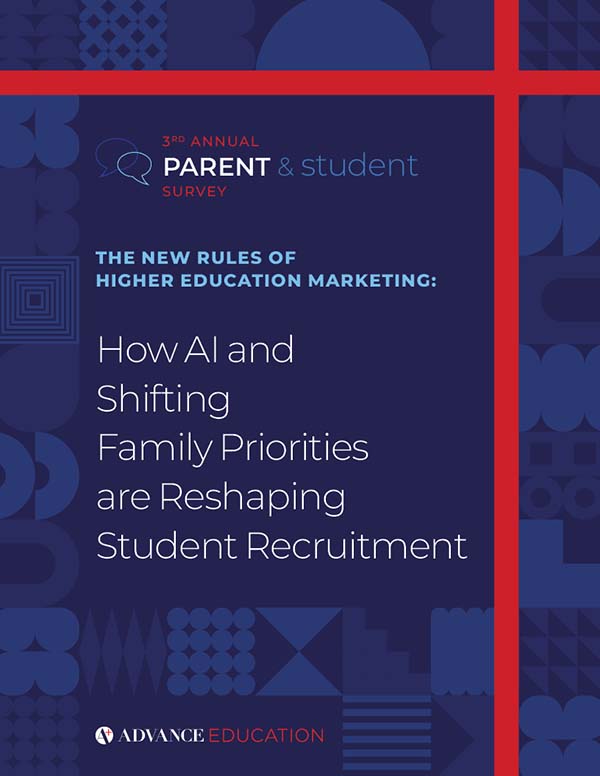
3rd Annual Parent & Student Survey
The New Rules Of Higher Education Marketing
How AI and Shifting Family Priorities are Reshaping Student Recruitment
AI isn’t new. It’s normal. Students and parents alike are increasingly using LLMs for research – for everything from homework help to their best options for higher education. If families already use AI to choose, the question is: how is your institution meeting them there? Our latest whitepaper outlines how to publish AI-readable answers to the most asked questions, making your value legible to both humans and machines.