
INSIGHTS
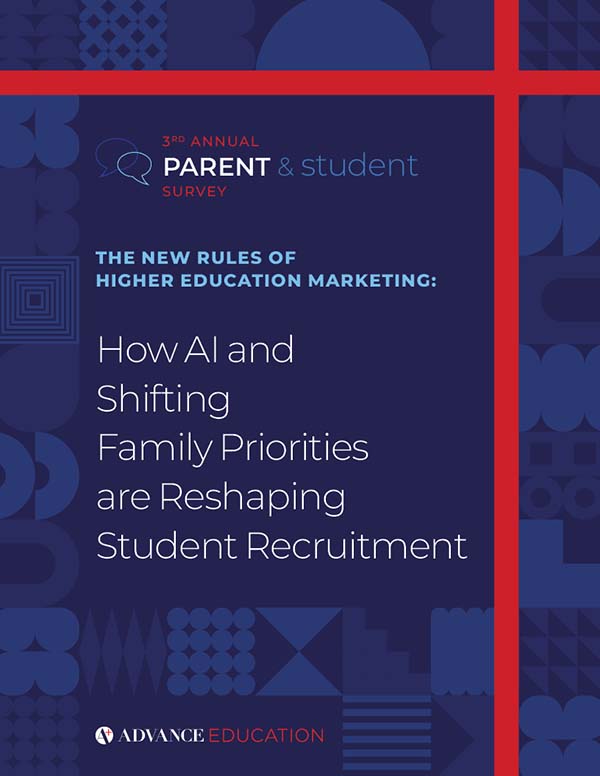
OUR LATEST WHITEPAPER
3rd Annual Parent & Student Survey
The New Rules Of Higher Education Marketing
How AI and Shifting Family Priorities are Reshaping Student Recruitment
AI isn’t new. It’s normal. Students and parents alike are increasingly using LLMs for research – for everything from homework help to their best options for higher education. If families already use AI to choose, the question is: how is your institution meeting them there? Our latest whitepaper outlines how to publish AI-readable answers to the most asked questions, making your value legible to both humans and machines.
Study Hall: Latest Insights
Read the latest Advance Education Insights posts here. From new technologies coming on the higher education field or practical marketing tips that help you shine in your role, we aim to cover all the topics you find of interest.
If you have any request for content, please let us know and we will add to our content schedule. Check back for more blog content weekly!

Featured Posts

The College Search: Parents and Students Value Proposition Compared
According to our annual survey, parents and their students – perhaps surprisingly – value nearly the same aspects of the post-secondary education experience and are mostly on the same page about their larger concerns.

How Students and Parents are Making Post-Secondary Decisions
Through our latest annual survey, we learned a great deal about the higher education decision making process for both students and their parents. We uncovered some overlapping influences as well as some divergent ones, and saw just how much some things matter to each target segment.

Survey Insights: The Challenges and Opportunities
In our 2nd Annual Parents and Students Post-Secondary Education Survey, we outline how all institutions – public and private four-year schools, community colleges, and vocational education programs – can work through or mitigate significant challenges impacting enrollment, including the Enrollment Cliff, rising education costs and ROI of post-secondary education, labor market demands and much more.
Second Annual Parents and Students Survey
In our 2nd Annual Parents and Students Post-Secondary Education Survey, we uncovered the motivations driving the most targeted segments for education marketers: high school students and their parents. We outline how all institutions – public and private four-year schools, community colleges, and vocational education programs – can work through or mitigate the current challenges impacting post-secondary enrollment.

Can Dual Enrollment Help Fill Higher Education Classrooms?
Higher education institutions of all types are under intense pressure from drops in enrollment. Finding more pathways to bring students into an institution can help colleges survive this national enrollment slump. One way to deliver a smoother pathway to college for some students is to partner with high schools to offer dual enrollment courses. Dual enrollment courses can potentially encourage students who wouldn’t otherwise have considered college to enroll after high school.

Implicit Marketing: Understanding Your Target Prospects (part 2)
The first step in reevaluating your implicit messaging is understanding your prospective students more fully. Each group of likely students will view your school through a different lens. First-generation high school graduates with immigrant parents may need to see more students like themselves represented in your materials, while a “some college, no degree” entering student may be more impressed by the range of flexible options that allow them to change their course load to accommodate their family and work lives.

Pillars of Higher Ed Enrollment Marketing: Continuous Analysis and Optimization
The only constant in life and business is change. The ability to adapt and evolve is critical for sustained success. By delving into the metrics and employing strategic optimization, colleges and universities can secure a competitive advantage, can boost efficiency and effectiveness over time and improve ROI.

How To Attract Underserved Students with Implicit Marketing (part 1)
Enrollment marketing is more challenging than ever with the changes rocking higher education and the demographic enrollment cliff. Plus, with the changes to diversity recruitment brought on by the Supreme Court decision about affirmative action, it is incumbent upon higher education institutions to find ways to ensure that underserved students—low-income, BIPOC, and first-generation—continue to enroll.

Pillars of Higher Ed Enrollment Marketing: Engage And Nurture Relationships
Engaging and nurturing relationships with prospective students is crucial for successful enrollment marketing in a highly competitive landscape. In summary, institutions must design marketing strategies that align with specific audience segments, consider every stage of the funnel, and ensure each stage is set up with detailed campaign tracking for optimization.