Instagram’s Shift and What It Means for Higher Education Marketers
Instagram’s leadership made headlines recently with a clear signal that the visual culture that once defined the platform is changing. Adam Mosseri, head of Instagram, shared a candid assessment of where the platform is headed, arguing that highly polished imagery no longer holds the same value it once did. Advances in AI, he noted, have made beautiful visuals easy to generate and increasingly indistinguishable from one another. As a result, Instagram is placing greater emphasis on content that feels human, spontaneous, and grounded in real moments.
For higher education marketers, this shift has meaningful implications. Many colleges and universities have long relied on striking, professionally produced photography to shape perceptions of campus life, academics, and student experience. Those assets are not suddenly obsolete, but their role within Instagram’s ecosystem is changing. The platform is showing that attention will increasingly flow toward content that feels lived in rather than staged and personal rather than perfected.
Mosseri’s argument centers on scarcity. When flawless images were difficult to produce, they served as a signal of effort, access, and craft. AI has disrupted that equation. When anyone can generate a pristine campus scene or idealized classroom snapshot in seconds, those visuals lose their ability to stand out. What becomes valuable instead is content that carries texture, such as imperfect framing, ambient sound, candid interactions, and moments that appear unrehearsed.
For higher education marketers, this reflects a broader shift in audience expectations. Prospective students increasingly want to understand what an experience feels like, not just what it looks like. They are drawn to content that conveys atmosphere, emotion, and context. A sweeping campus landscape can still inspire interest, but a short video showing a student navigating classes, conversations with peers, and everyday campus life may build deeper trust and relatability.
AI also introduces a growing challenge around credibility. As synthetic imagery becomes more sophisticated, audiences may begin to question whether what they are seeing actually exists. Instagram’s move toward rawer content can be seen as an attempt to restore confidence through visual cues that suggest human presence. For colleges and universities, this places greater emphasis on storytelling and context in social media content.
Algorithmic incentives are evolving along with these cultural shifts. Content that signals immediacy and participation, such as quick reels, informal clips, and behind the scenes moments, may receive more organic reach than carefully curated grids. This suggests a need to diversify content strategies beyond hero imagery.
This shift does not eliminate the role of professional photography. High quality visuals remain essential for websites, paid media, print materials, and long form storytelling. What is changing is how Instagram prioritizes content within its feed.
Instagram’s evolution reflects a broader cultural adjustment to an AI saturated media landscape. For higher education marketers, the opportunity lies in leaning into what technology cannot easily reproduce. That includes human experience, emotion, and real connection.





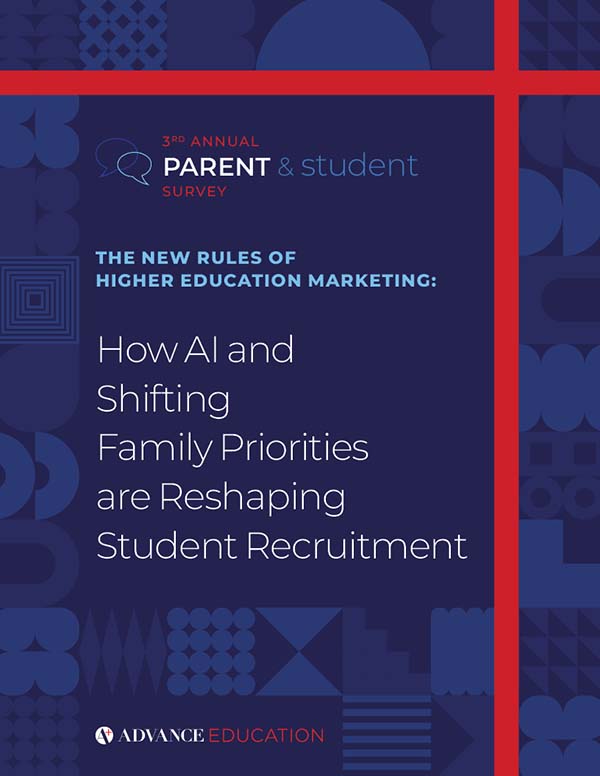
OUR LATEST WHITEPAPER
3rd Annual Parent & Student Survey
The New Rules Of Higher Education Marketing
How AI and Shifting Family Priorities are Reshaping Student Recruitment
AI isn’t new. It’s normal. Students and parents alike are increasingly using LLMs for research – for everything from homework help to their best options for higher education. If families already use AI to choose, the question is: how is your institution meeting them there? Our latest whitepaper outlines how to publish AI-readable answers to the most asked questions, making your value legible to both humans and machines.